
Why Aren't They Doing What You Asked?
Research shows that 60–80% of workplace performance problems trace back to how leaders communicate - not employee shortcomings. If someone on your team isn't delivering, the reason is probably not what you think.
Mark Sanborn, leadership author and speaker, identifies five root causes behind virtually all workplace non-performance. What's striking is where the weight falls: the first three reasons, covering the vast majority of cases, are fully within the manager's control to fix.
The 5 Reasons at a Glance
- They don't know what to do - a clarity & communication gap (most common)
- They don't know how to do it - a training or resources gap
- They don't know why it matters - a motivation gap
- They genuinely can't do it - an inherent ability issue (rare)
- They're choosing not to - insubordination (rarest of all)

Reason 1: You Haven't Been Clear Enough
The most common reason - and the most fixable
The most common reason employees don't perform is surprisingly simple: they don't actually know what you want. Not because they're inattentive, but because what seems obvious to a manager is rarely as clear to the person receiving the request.
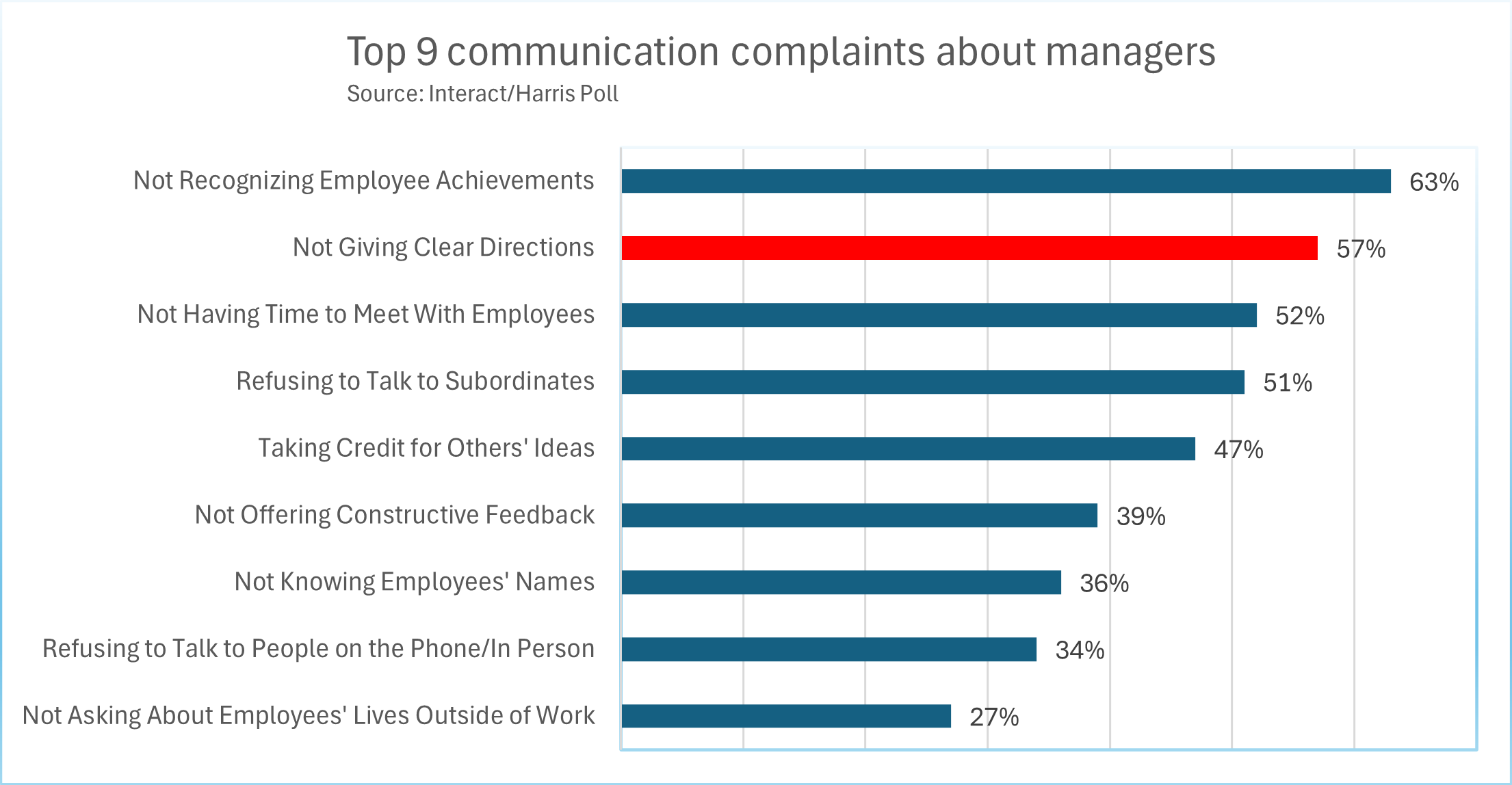
A widely-cited Interact/Harris poll found that 57% of employees list unclear directions from their manager as a top frustration. We can trace 60–80% of all workplace performance issues directly to poor or ineffective communication.
A Real-World Example
A facilities director tells her maintenance team to "keep the building looking professional." Three weeks later she's frustrated - but she never defined what "professional" meant, by whose standard, by when, or how it would be measured. The team wasn't failing her. They were flying blind.
What You Can Do
- Define the outcome, not just the task. Describe what success looks like when the work is done - the "after" picture. People can't hit a target they can't see.
- Cover all five dimensions: What (the outcome), Why (the reason it matters), How (recommended approach), How well (quality standard), and By when (the deadline). Most managers skip the last two.
- Define priority. If someone has five tasks, they need to know which one takes precedence right now.
- Set layered expectations:
- Minimum - the baseline requirement of the role
- Desired - what you believe they're genuinely capable of
- Potential - "Let's find out how good you can be." Goals alone inadvertently cap performance; people relax once they've hit them. A stretch challenge prevents this.
- Don't micromanage. Research from the University of Southampton found that employees perform better when given autonomy within a clear framework, not when every step is prescribed.
Reason 2: They Have the Will, But Not the Skills
Motivation without ability leads nowhere
Sometimes an employee genuinely wants to perform but lacks the training, knowledge, or resources to do it well. This is easy to misread as low motivation or indifference, but it's neither.
Performance = Ability × Motivation
— Whetten & Cameron, Developing Management Skills
The multiplication matters. If ability is near zero, motivation can't save the outcome. Both sides of the equation need attention.
A Real-World Example
A long-serving office manager is asked to take over project scheduling using a new platform. She's experienced, reliable, and wants to do a good job, but she's never used the software and hasn't been offered training. Her "underperformance" is a resource and training gap, not a motivation problem.
What You Can Do
Start by removing barriers. Ask: what's actually preventing them from doing better work? Your job as a manager is to unblock your team, not just evaluate it.
Check for resource gaps:
- Are the tools and resources available to them actually sufficient for the task?
- Where are the friction points? Where do they say support falls short?
- Verify through your own observation: people sometimes attribute skill gaps to external factors. Both can be true simultaneously.
Check for knowledge and skills gaps:
- Do they have the skills the role now demands? Given the pace of technology change, skill decay is real and underappreciated.
- Provide targeted training - specific to the identified gap, not generic.
- Investing in their development signals that you value them. That alone lifts motivation.
Reason 3: They Don't See Why It Matters
Compliance and commitment are not the same thing
For people to genuinely want to do something, they need compelling reasons that make sense to them. Motivation is the difference between compliance (doing it because they have to) and commitment (doing it because they want to).
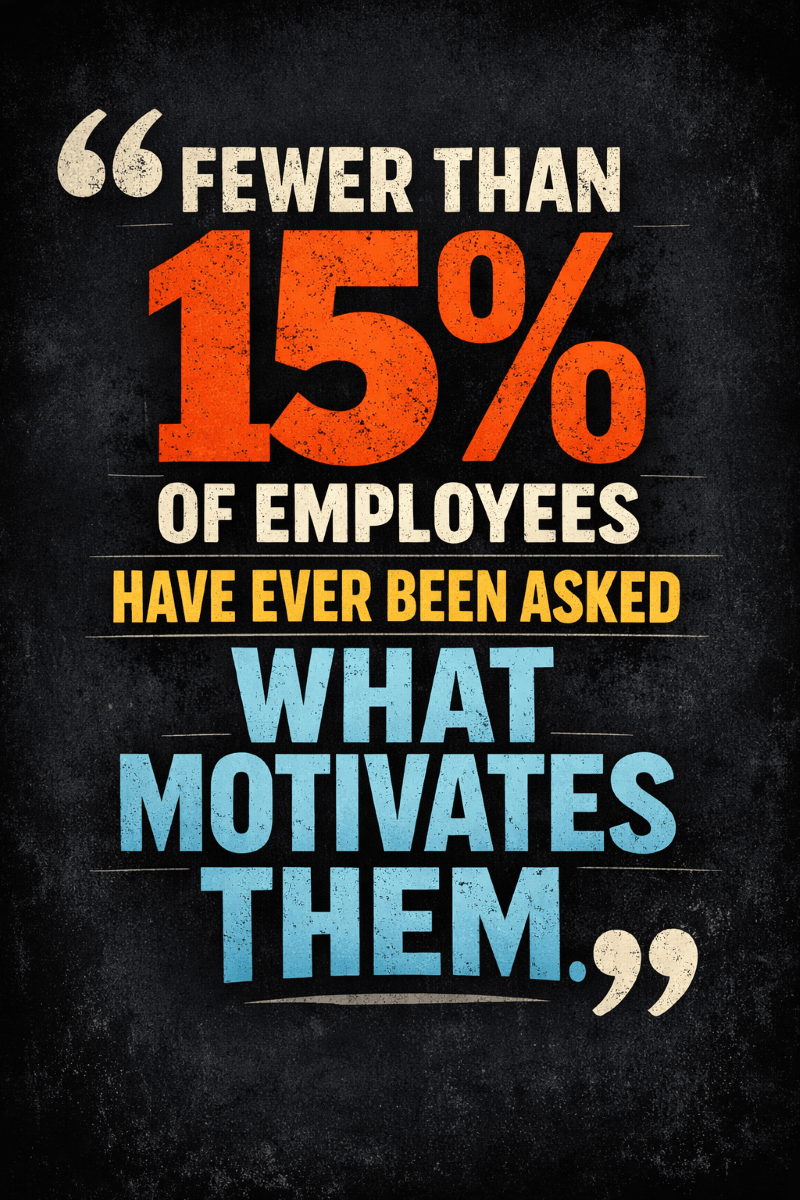
Here's a striking data point: fewer than 15% of employees have ever been asked what motivates them. That means 85% of attempts to motivate people are based on assumptions - often wrong ones.
Tell Them the "Motivational Why"
When assigning a task, explain why it matters - not just the business rationale, but how it connects to what the employee cares about. Mark Sanborn calls this the "motivational why."
Many managers interpret "why?" as a challenge to authority. In reality, it's a sign of engagement. People who understand the purpose behind their work invest more in the outcome.
"Unless we take the time to thoroughly communicate why something is needed and how it fits the big picture, people feel 'managed' - and resentment follows." — Mark Sanborn
Recognition Matters More Than You Think
In the same Interact/Harris poll, the number one complaint employees had about their managers was that they don't recognise their achievements. Not pay. Not workload. Recognition.
"Money is not a motivator. If you give people more money you might get a quick lift in productivity, but the effect dies off incredibly quickly. By and large, that is not what employees are there for." — Malcolm Higgs, University of Southampton
Specific, genuine acknowledgement - "I noticed how you handled that difficult conversation on Tuesday, and it made a real difference" - consistently outperforms generic praise or financial incentives in sustaining motivation over time.
Personalise Your Approach
What motivates one person won't motivate another. Gallup research consistently shows that employees who feel their manager understands what drives them are significantly more engaged and less likely to leave. Contemporary employees (particularly Millennials and Gen Z) tend to value:
- Autonomy and genuine ownership over their work
- Opportunities to learn, grow, and develop
- Flexible working arrangements
- Being part of a team with a clear, meaningful purpose
Build a Motivational Environment
Robert Levering's research, summarised in A Great Place to Work, found that employees consistently describe their best workplaces in three ways:
- Trust - they trust who they work for. Be trustworthy and people will trust you.
- Enjoyment - they enjoy who they work with. Make it OK to have fun at work. People know they need to be serious about results but need the freedom to enjoy doing it.
- Pride - they're proud of what they do. People want to be part of a winning team. The greatest thing you can do for an employee is give them the freedom to make money and meaning.
Model the Behaviour You Expect
As managers, everything we do promotes or pollutes the culture around us. You are the thermostat, not the thermometer. If you want an energised, committed team, they need to see that energy and commitment from you first.
Reason 4: They Genuinely Can't Do It
Rare - but important to recognise honestly
This is the scenario that feels most uncomfortable to acknowledge: your team member has been properly trained, has the resources they need, understands the purpose, and still can't perform. Not because they don't want to, but because the required capability is genuinely beyond them.
This is distinct from Reason 2 (a training gap you can close). Here, the gap can't be closed through more training or support. It's a fundamental mismatch between the person and the role.
A Real-World Example
A technically brilliant engineer is promoted into a management role because of their exceptional individual performance. Despite training, coaching, and genuine effort over 18 months, they struggle significantly with team leadership. Their strengths lie in deep technical work, not leading people. The right solution may not be more coaching. It may be a senior individual contributor role where they can genuinely excel.
What You Can Do
First, be honest that you've genuinely exhausted the Reason 2 solutions. If you have:
- Identify whether the tasks in question are core to the role. Can they be redistributed or reallocated while leaving the employee with meaningful, appropriate work?
- Consider reassignment. Sometimes the right move is matching the person to a role that plays to their actual strengths, which may mean a lateral move, not a demotion.
- Act sooner rather than later. Delaying a difficult decision doesn't make it easier; it makes it harder on everyone, including the employee, who deserves clarity about their situation.
Reason 5: They're Choosing Not To
The least common reason - and the one managers most often assume first
Genuine insubordination - a deliberate, conscious refusal to perform - is far rarer than most managers assume. And yet it's often the first explanation managers reach for when confronted with non-performance. That impulse is understandable, but assuming bad faith before exploring the first four reasons is a management error that damages trust and compounds the problem.
That said: when true insubordination does occur, it is serious and must be addressed directly. Tolerating it signals to your entire team that non-compliance has no consequences and that undermines everyone who is doing their job well.
What You Can Do
- Document the pattern - specific incidents with dates, what was asked, and what was or wasn't done.
- Have a direct, private conversation - make clear that performance expectations are not optional, and give the employee an opportunity to explain their perspective.
- Follow your organisation's disciplinary process - formal written warnings, a structured performance improvement plan, and if necessary, termination.
- Act decisively. Your team is watching. How you respond to deliberate non-performance shapes the culture for everyone.
The Bottom Line
When someone on your team isn't performing, resist the impulse to diagnose from your desk. The five reasons above give you a structured framework for investigation - and they almost always point back to something a good leader can directly influence.
| Reason | Root Cause | Your Move |
|---|---|---|
| 1. Don't know what to do | Clarity gap | Define outcomes, standards, deadlines |
| 2. Don't know how to do it | Training / resources gap | Remove barriers, provide targeted training |
| 3. Don't know why it matters | Motivation gap | Explain the why; personalise recognition |
| 4. Genuinely can't do it | Inherent ability mismatch | Reassign, restructure, or exit |
| 5. Choosing not to | Insubordination | Document, confront directly, follow process |
The good news: the first three reasons - which cover the overwhelming majority of performance problems - are fully within your control as a leader. Better clarity, better development, and a deeper understanding of what drives your people will resolve most of what frustrates you.
Want to develop these skills across your leadership team?
Crestcom's leadership development program addresses all five root causes - through practical, applied training that sticks.
Talk to Us About Your Team →